


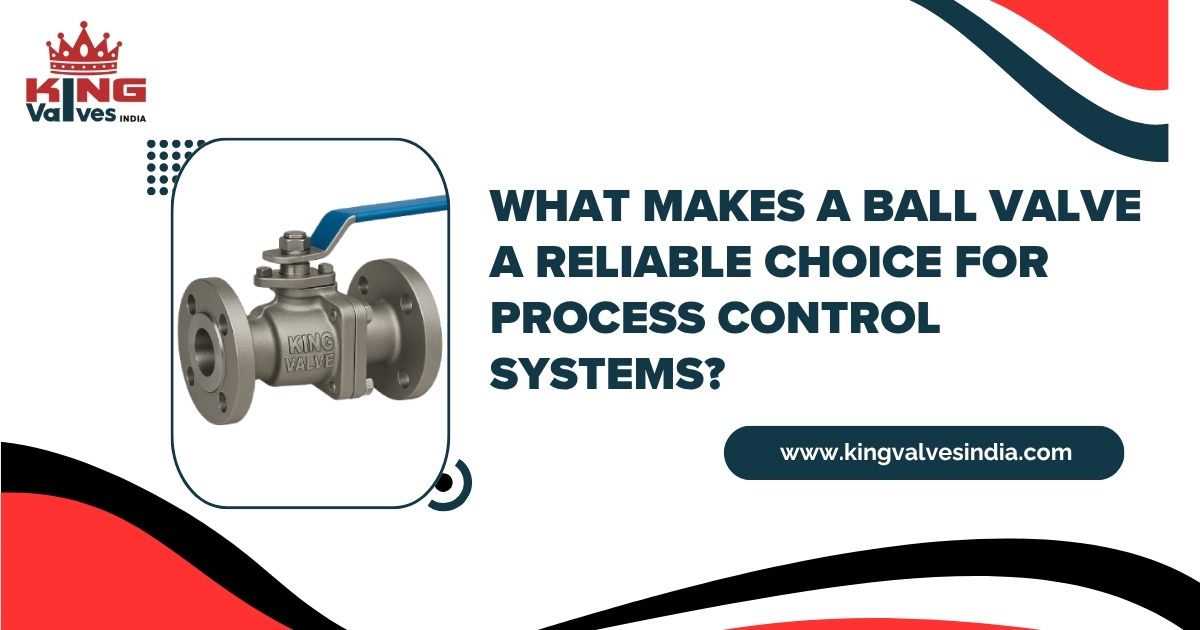
A ball valve is commonly selected in process control systems due to its simple rotational operation and capacity to offer shut off with very low flow resistance. This valve uses a spherical ball with a bore through the center. When this bore aligns with the pipeline, fluid passes through freely. When rotated ninety degrees, the bore no longer aligns with the line and flow is stopped. This quarter-turn movement makes the valve direct in operation and suitable for applications where frequent opening and closing cycles take place throughout a working shift.
In several industrial plants, process conditions change throughout the day, and operators need equipment that reacts quickly. A ball valve fits into this requirement because it can be actuated manually with a handle or integrated with automation through pneumatic or electric actuation. For industries aiming for controlled upstream and downstream flow balance, this valve offers a structured method of adjusting flow without complicated internal mechanisms.
King Valves India, based in Ahmedabad, sees regular demand from water projects, chemical processing facilities, food and beverage transfer systems, and gas line applications. As a Ball Valve Manufacturer in India, the company experienced that the industrial market values this valve type in both compact pipelines and long-distance networks because the working mechanism is friendly for technicians and maintenance staff in field conditions.
Internal Components That Support Industrial Performance
Ball Element
The ball inside the valve body rotates to open or close the passage. It is usually polished to reduce turbulence and avoid flow drag. Size, surface finishing and internal geometry determines how smooth the flow pattern moves across the body.
Body Construction
The outer shell protects internal parts from stress. Depending on application, the body can be metallic such as stainless steel or cast steel, or polymer based for corrosive media or lightweight duties.
Stem or Shaft
Connects actuator or handle to the ball. It transfers rotation directly without complicated linkages, which keeps response immediate.
Seats and Seals
Polymers like PTFE are commonly used in seat areas. These provide line contact during closure, improving shut off performance under varying pressure ranges.
How a Ball Valve Supports Process Control Systems in Real Situations
Water Treatment Networks
Used for pumping lines, chemical dosing zones and distribution points where frequent control is required.
Petrochemical and Chemical Processing
Used for transfer, isolation and bypass duties in medium and high pressure environments.
Steam and Thermal Fluid Circuits
Used with high temperature compatible sealing materials for heat transfer loops.
Food and Beverage Pipelines
Polished internal ball surface helps maintain clean flow and minimal turbulence in hygienic media.
Gas Handling Systems
Used where sharp isolations are required without long closing time delay.
Ball valves offer a flow profile that is consistent and predictable. This makes it easier to calculate flow coefficients and energy usage across a pipeline segment. Process engineers prefer equipment that responds quickly, so step changes in flow can be controlled without time gaps.
Selection Factors Before Choosing a Ball Valve
Pressure Class and Size Range
Different projects demand different working pressure ratings. Higher pressure lines require strong construction and tight sealing compatibility.
Material Choice
For corrosive chemicals or harsh media, material selection becomes very important. Correct grade selection defines life cycle performance.
Seat and Seal Selection
PTFE is common in this segment, although special materials are also used where temperature or media conditions need alternate seat design.
Actuation Type
Depending on automation requirements, ball valves can be operated manually or integrated with gear, pneumatic or electric actuators.
These factors indicate that selecting a valve is always engineering driven. Each process has unique flow requirements, operating pressure variations and media specification variations.
Why Choose Us
King Valves India, located in Ahmedabad, focuses on manufacturing ball valves that serve practical industrial process requirements. Instead of merely looking at catalogue data, the company studies real working conditions and selects material combinations that match industrial application zones in the Indian market. This helps operators use a valve that matches actual environments where flow control cycles repeat frequently.
As a Ball Valve Manufacturer in India, the development approach includes feedback collection from users across different sectors such as water systems, chemical plants, packaging conveyor lines, compressed gas units and machine automation networks. Input from these multiple segments helps the company improve product suitability for day to day industrial working conditions rather than building generic patterns.
This application-based understanding results in ball valves that maintain consistent movement response during operation. OEMs, contractors, integrators and maintenance teams prefer equipment that responds to process changes without complicated adjustment methods. King Valves India follows this approach for continuous development.
Conclusion
Ball valves support industrial operations efficiently because the quarter-turn movement is direct and friendly for both manual and automated operation. This type of valve can handle system variations, frequent open-close cycles, and multiple media types in industries like chemicals, pumping networks, water management, gas distribution, thermal fluid lines and beverage transfer.
The selection of the correct body material, seat material, pressure class and actuation type plays an important role in achieving steady flow performance in the long run. Indian industries continue to expand across infrastructure networks, and valve equipment that can support real process control behaviour is gaining more attention.
King Valves India from Ahmedabad supplies ball valves engineered with application knowledge related to Indian conditions. This practical orientation helps industrial projects run with smoother process adjustments while maintaining field friendly operation for maintenance staff and plant teams.


